
What Is Computational Thinking and Why Does Your Child Need It? How to Choose the Best CBSE schools in Navi Mumbai
Home / cbse education / What Is Computational Thinking and Why Does Your Child Need It? How to Choose the Best CBSE schools in Navi Mumbai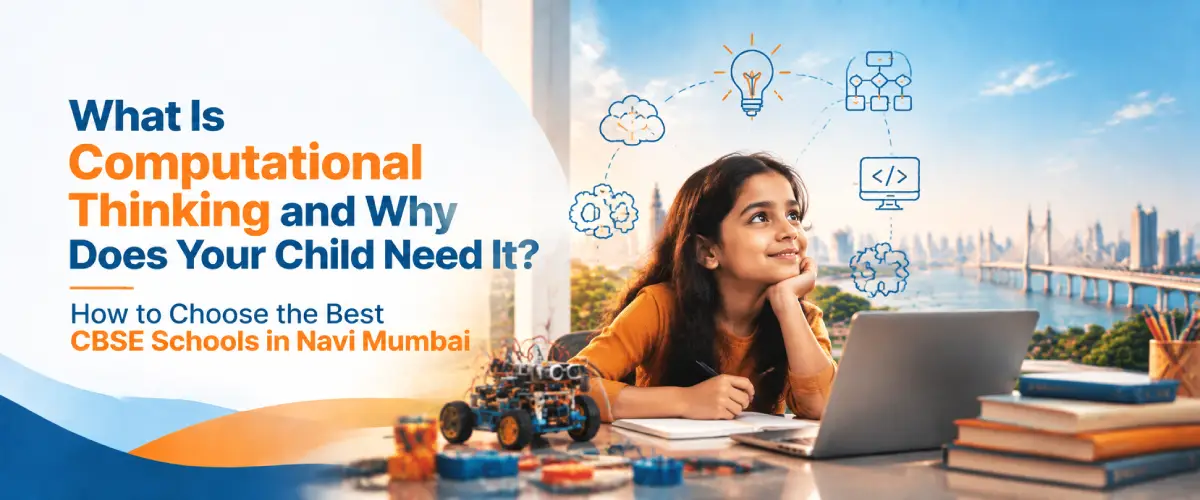
Computational thinking is the skill of breaking a big problem into small parts, spotting patterns and working out clear steps to solve it, much like a computer follows instructions. It is not the same as coding. CBSE has now added it to the official curriculum for Classes 3 to 8 from the 2026-27 session. Parents comparing CBSE schools in Navi Mumbai should check how well a school builds this skill, since it shapes how a child works through every subject, not only computer periods.
Introduction
Most parents want one thing for their child: the skill to work through a problem calmly and reach an answer without help. That is what computational thinking teaches. It breaks a tricky question into small, manageable steps and works through each step in order. Schools across India now pay close attention to this skill, and many CBSE schools in Navi Mumbai have started weaving it into everyday lessons, not just computer periods. This article explains what computational thinking means, why it matters for a child’s future, and how parents can check whether a school teaches it well. It also looks at how MNR School of Excellence builds this skill through its classrooms and facilities, so parents looking for the best CBSE schools in Navi Mumbai know what questions to ask at an admission visit.
What Is Computational Thinking, Really?
Computational thinking is a method of solving problems. A child using it breaks a big task into smaller parts, looks for patterns, sets aside details that do not matter right now, then builds a step by step plan to reach the answer. Researchers Shuchi Grover and Roy Pea of Stanford University describe four parts of this skill: decomposition, pattern recognition, abstraction and algorithm design. A child does not need a computer screen to use them. Packing a school bag in order, planning a badminton match or solving a math word problem all use the same kind of thinking.
The Four Building Blocks of Computational Thinking
| Building Block | What It Means | Everyday Example |
|---|---|---|
| Decomposition | Breaking a big problem into smaller, easier parts | Splitting a science project into research, writing and drawing |
| Pattern Recognition | Spotting what repeats or looks similar | Noticing that multiples of 5 end in 0 or 5 |
| Abstraction | Setting aside details that do not matter right now | Using a simple map instead of every building to find a route |
| Algorithm Design | Writing clear, ordered steps to reach an answer | Following a recipe step by step to bake a cake |
How It Is Different From Coding
Coding is writing instructions in a language a computer understands. Computational thinking is the reasoning that comes before that, the plan a child builds before writing even one line of code. A child can be good at computational thinking without ever touching a keyboard. This is why good CBSE schools in Navi Mumbai now teach it through puzzles, group work and everyday classroom problems, not only in the computer lab.
Why Your Child Needs Computational Thinking Today
It Helps With Every Subject, Not Just Computers
A child who thinks this way reads a maths problem, a science experiment or even a history question with more order in the mind. Grover and Pea note in their widely read review that computational thinking supports problem solving across science, technology, engineering and mathematics, not computer studies alone. A history answer broken into cause, event and effect uses the same decomposition skill as a coding project. This is true for any CBSE school in Navi Mumbai that takes early skill building seriously.
CBSE Has Already Changed the Curriculum
CBSE launched an official Computational Thinking and AI curriculum for Classes 3 to 8 starting the 2026-27 session, built with an expert committee from IIT Madras and launched by the Union Education Minister on 1 April 2026. Classes 3 to 5 will study this for 50 hours a year, worked into subjects such as mathematics and environmental studies, with no separate exam. Classes 6 to 8 will study 100 hours a year, split between computational thinking and AI literacy as structured modules. A child in CBSE schools in Navi Mumbai will now meet this skill through the regular school day, not as an extra activity.
| Class Group | Hours Per Year | How It Is Taught |
|---|---|---|
| Classes 3 to 5 | 50 hours | Worked into Mathematics and The World Around Us, no separate exam |
| Classes 6 to 8 | 100 hours | Structured modules covering computational thinking and AI literacy |
| Classes 9 to 10 (proposed) | Under review | Advanced computational thinking and AI as compulsory subjects |
| Classes 11 to 12 (proposed) | Under review | Core AI and machine learning as elective subjects |
Why This Matters for Careers Later
The World Economic Forum’s Future of Jobs Report 2025 gathered answers from over 1,000 employers across 55 economies. It found that seven out of ten employers name analytical thinking as the top skill they look for in a worker. Resilience and flexibility came next, followed by technological skill. The report also expects close to two in five of a worker’s core skills to change by 2030. A child who learns computational thinking early builds exactly the kind of analytical base these numbers point to.
| Rank | Skill Employers Want | Share of Employers Who Rate It Core |
|---|---|---|
| 1 | Analytical thinking | 69% |
| 2 | Resilience, flexibility and agility | 67% |
| 3 | Leadership and social influence | 61% |
| 4 | Creative thinking | 57% |
| 5 | Technological literacy | 51% |
How Good CBSE Schools In Navi Mumbai Teach This Skill?
Classrooms that teach this well bring together three things: activity based learning, subject integration and the right facilities. A physics lab where a child plans a small experiment step by step is teaching computational thinking. A chess period where a child works out moves ahead is teaching it too. A language lab that breaks grammar rules into patterns does the same work in a different subject.
What Parents Should Check
Before choosing among CBSE schools in Navi Mumbai, parents can use these four questions during a campus visit.
| Question to Ask | Why It Matters | What a Good Answer Sounds Like |
|---|---|---|
| Is this taught daily or only in a computer period? | CBSE now expects it across subjects | It comes up in maths, science and language classes too |
| Are there labs and activity spaces for practice? | A child learns this skill by doing, not by reading alone | A working Physics Lab, Chemistry Lab and Resource Centre |
| Does the school offer chess or logic based activities? | These build the same four skills directly | Chess periods, group puzzles, project work |
| How long has the school followed this teaching method? | Experience shapes how well a method is delivered | A track record spanning decades |
MNR School of Excellence And What Sets It Apart
MNR School of Excellence stands among the CBSE schools in Navi Mumbai built on this approach every single day. It brings together fifty years of school experience with an award winning activity based teaching method built around all round growth. Its classrooms use Smart Boards, a Physics Lab, a Chemistry Lab and a Resource Centre for everyday practice. Chess, arts and crafts and dance training run alongside sports and games. A Language Lab, guest lectures, yoga and self defence training round off the week. Parents searching for top CBSE schools in Navi Mumbai often ask about one or two of these facilities on their own. MNR School of Excellence offers all of them under one roof, alongside a teaching method built to grow a child’s ability to think and solve problems.
| USP | What It Gives a Child |
|---|---|
| 50 years of school experience | A teaching method refined over decades |
| Award winning activity based teaching | Learning by doing, not only by reading |
| Smart Board, Physics Lab, Chemistry Lab | Hands-on practice with computational and scientific steps |
| Chess, Arts & Crafts, Dance Training | Pattern spotting, planning ahead and creative problem solving |
| Language Lab, Guest Lectures | Wider exposure and stronger communication |
| Yoga and Self-Defence | Focus, discipline and confidence alongside academics |
Signs Your Child Already Shows Computational Thinking
A parent does not need a school report to spot early signs of this skill. A child who sorts toys by colour or size is using pattern recognition. A child who plans a board game move two steps ahead is using algorithm design. A child who breaks a big homework task into a short list before starting is already using decomposition, the same skill CBSE now teaches by name.
Conclusion
Computational thinking is no longer a topic kept inside the computer lab. It is now part of the CBSE curriculum, it shapes how a child handles every subject, and it builds the kind of analytical thinking employers say they will look for by 2030. Parents comparing CBSE schools near Navi Mumbai should ask how a school builds this skill day to day, not only what its computer lab looks like. Schools such as MNR School of Excellence, with fifty years of teaching experience and activity based classrooms, give a child a real head start. For families weighing the best schools in Navi Mumbai, this is one question worth asking at every admission visit.
Frequently Asked Questions
It is a way to break a big problem into small steps and solve each step in order, the same way a computer follows instructions. A child can use it in maths, science, games or daily chores.
No. Coding is writing instructions for a computer. Computational thinking is the planning and reasoning a child does before writing any code, and it applies far beyond computer class.
CBSE now introduces it from Class 3 onward, worked into subjects such as mathematics and environmental studies. Many schools also build early versions of it through games and puzzles in the primary years.
Yes, for Classes 3 to 8 from the 2026-27 session. It is built into existing subjects for Classes 3 to 5 and taught as structured modules for Classes 6 to 8.
Classes 3 to 5 get 50 hours a year and Classes 6 to 8 get 100 hours a year, split between computational thinking and AI literacy.
Because it is now part of the official curriculum, and because it builds problem solving ability that helps a child across every subject, not only computer studies.
Yes. It supports clearer answers in maths, science and even language subjects, since breaking a question into steps works the same way across subjects.
Chess, puzzles, board games, cooking with a recipe and even sorting a cupboard by category all build the same four skills that CBSE now teaches by name.
Through activity based classrooms that use a Physics Lab, Chemistry Lab, chess and guided projects, alongside a teaching method built over fifty years.
For Classes 3 to 5, CBSE has said there is no separate exam, since it sits inside existing subjects. Classes 6 to 8 follow it as structured modules within the school year.
Employers across sectors rate analytical thinking as their top skill requirement, according to the World Economic Forum's Future of Jobs Report 2025, so almost every career field values a child who has built this skill early.
Related Blogs

How to Choose the Best School Near JNTU Hyderabad
Choosing the best school near JNTU Hyderabad means looking past the building. Parents should check…
From Exploring the List of Schools in Kamothe to Career: Why Early Skill Development Matters?
Early skill development means building abilities such as critical thinking, communication, collaboration and problem solving…
Why Competency-Based Learning Matters for Secondary School Students: A Guide from CBSE Schools in Kukatpally
Competency-based learning means students learn to use what they study, not just remember it. It…
How CBSE Schools in Kamothe Are Preparing Students for Future Careers and Competitive Exams
Choosing the right school is one of the biggest decisions for parents. Academic performance matters,…
Why Personalized Learning and Experiential Education Are Shaping the Future of Schooling in India
Education in India has changed considerably over the last few years. Many parents and students…

How to Choose the Best CBSE School in Navi Mumbai for Your Child
The best CBSE schools in Navi Mumbai share six things. They hold a valid CBSE…
Leave a comment